The Uprising Has Arrived. So Where Are the Women?
I have to admit, I’m intrigued by The Uprising.
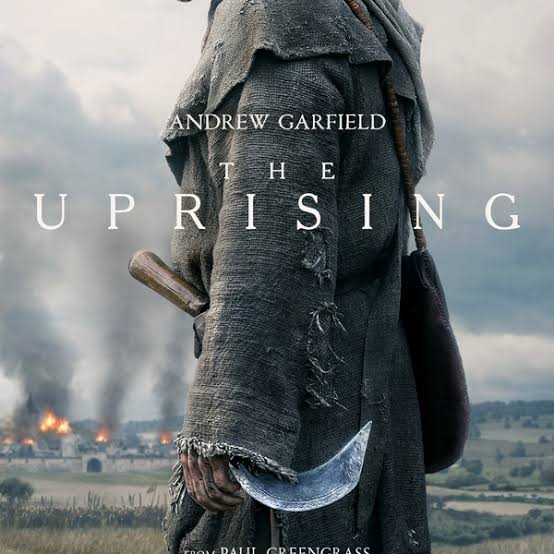
A major new film about the Peasants’ Revolt of 1381, with Andrew Garfield at its centre, bringing one of the most extraordinary popular uprisings in English history to a huge cinema audience.
I absolutely want to see it.
But I’m also asking a rather awkward question.
Where are the women?
Because when I look at the story of 1381, I see women everywhere.
Yet when I look at the way the story has traditionally been told — and at the male-heavy world presented in the publicity surrounding The Uprising — I see Wat Tyler, John Ball, the King, the Archbishop, the Treasurer and a whole cast of men.
And I find that frustrating.
Especially because the women of 1381 weren't simply standing on the sidelines.
It didn't simply begin with Wat Tyler
Two women from Kent, Joan Hampcok and Agnes Jekyn, have been identified in recent scholarship as being at the very beginning of the rising.
Their protest was connected to the hated poll tax and its collection from married women. They were subsequently imprisoned in Canterbury Castle, and later released when rebels broke open the prison.
Think about that for a moment.
We grow up hearing about Wat Tyler as the great name associated with the Peasants’ Revolt.
Yet there are women at the very beginning of the story.
And then there is Johanna Ferrour.
Now here is a woman Hollywood really could have had some fun with.
Ferrour was one of the rebel leaders who stormed the Tower of London. She was involved in the seizure of Archbishop Simon Sudbury and Treasurer Robert Hales — two men deeply associated with the hated government and the enforcement of the poll tax.
Both were subsequently beheaded.
Ferrour's role is recorded in the historical sources. One modern account describes her as leading a group that stormed the Tower and says that she had Sudbury and Hales beheaded.
This woman was not a bit-part.
She was right in the middle of the action.
And she wasn't alone.
There was Julia, the wife of Richard Poucher of Maidstone, who met with rebels from Essex and Canterbury and persuaded them to attack Maidstone gaol. The gaol was destroyed and the prisoners released.
There was Margery Starre in Cambridge, who became involved in the destruction of legal documents and was remembered for scattering their ashes to the wind.
There was Katherine Gamen, who played a part in the pursuit of Chief Justice John Cavendish, reportedly untying the boat in which he was attempting to escape.
And there were other women whose names have survived in the records — women such as Margaret Stafford, Matilda and Isabel Brembole.
These names matter.
Because every time we recover another woman's name from the medieval records, we are reminded that history was not happening exclusively to men.
Women were living it.
Women were angry.
Women were organising.
Women were protesting.
Women were attacking the institutions they believed were oppressing them.
Women were taking risks.
And sometimes women were leading.
So why don't we know their names?
This is the question that really interests me.
For generations, historians treated popular revolt as overwhelmingly a male affair. Modern scholarship has increasingly challenged that assumption, showing that women appear in judicial records, chronicles and other sources as independent participants, leaders, instigators and accomplices.
The evidence isn't always neat.
Medieval records are patchy. Some women's names survive while others have disappeared completely. Some accounts were written by men who had very good reasons for portraying rebels in particular ways.
But that is precisely why we need to look harder.
Because absence from the history books isn't the same thing as absence from history.
And this is where The Uprising has really caught my attention.
I haven't seen the finished film yet, so I'm not going to pretend that I know exactly how every woman is portrayed.
But from what has been released so far, the story appears overwhelmingly centred on male characters.
And that feels like a missed opportunity.
Because imagine a film about 1381 in which we actually saw Joan Hampcok and Agnes Jekyn at the beginning.
Imagine seeing Johanna Ferrour storming the Tower.
Imagine Julia Poucher standing outside Maidstone gaol demanding the prisoners be released.
Imagine Margery Starre throwing the ashes of legal documents into the air.
Imagine these women not as wives, mothers or background characters — but as participants in one of the most extraordinary uprisings in English history.
Now that would be a story worth watching.
In 2026, surely we can tell the whole story?
This isn't about taking anything away from Wat Tyler.
It isn't about pretending the men weren't important.
It is about refusing to tell half a story when the other half is sitting there in the records waiting to be rediscovered.
The Peasants' Revolt was a huge, complicated popular movement. It involved people from towns and villages, workers, craftsmen, servants and women as well as men. Modern historians have increasingly shown just how much more complicated the traditional story is.
So yes, I will be going to see The Uprising.
I'm fascinated to see how Hollywood has chosen to tell this story.
But I'll also be watching for the women.
Joan Hampcok.
Agnes Jekyn.
Johanna Ferrour.
Julia Poucher.
Margery Starre.
Katherine Gamen.
Margaret Stafford.
Matilda.
Isabel Brembole.
They were there.
They mattered.
And they deserve to be remembered.
Because her story is history too.
And that is exactly why I created London Herstory.
The women you weren't taught about.
The women who were there.
The women who changed the story.